Instagram vs YouTube vs Google : Where Should Small Businesses Spend in 2026?
In this article
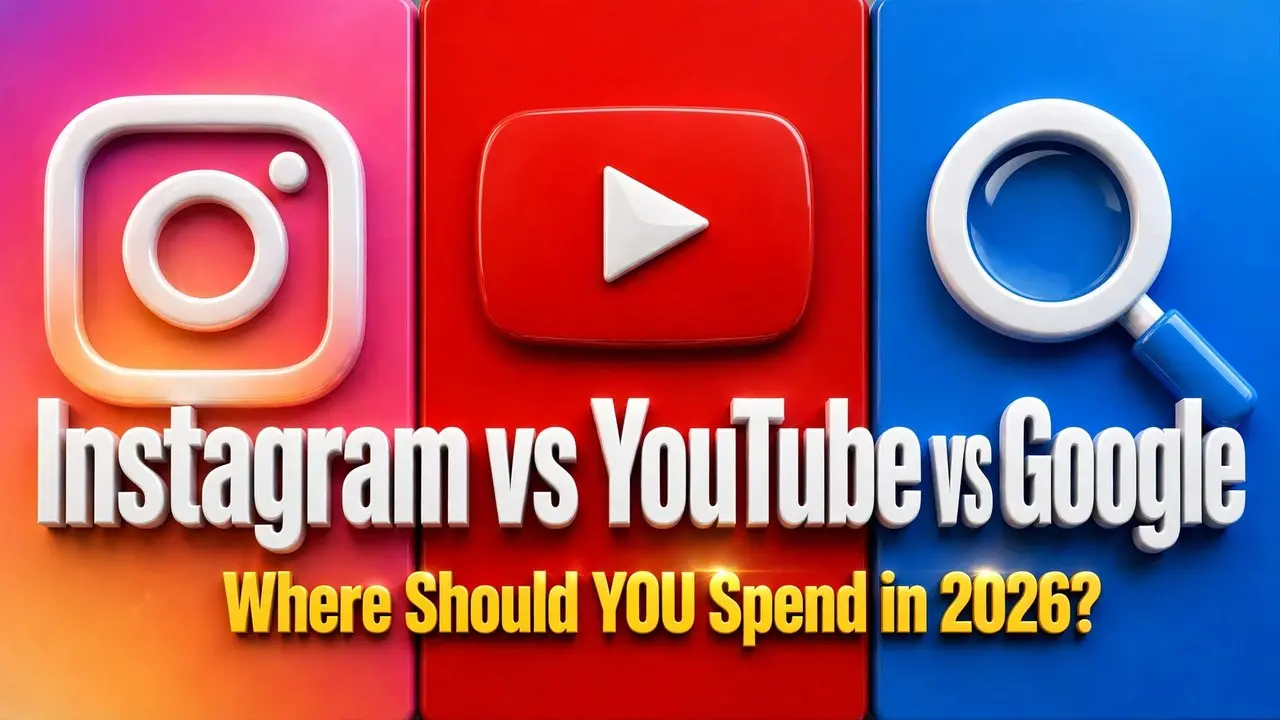
- The Three Platforms at a Glance
- Google Ads: Where Intent Lives
- Instagram Ads: Where Attention Lives
- YouTube Ads: Where Trust Is Built
- Head-to-Head: Cost Comparison (India, 2026)
- Which Platform for Which Business?
- The Real Answer: Stop Choosing, Start Layering
- Sample Budget Splits: ₹30,000/Month
- 5 Mistakes Small Businesses Make
Every small business owner in India asks the same question: should I spend on Instagram, YouTube, or Google? Most pick the platform they personally use the most — and that’s exactly why most ad budgets get wasted.
The honest answer: it’s the wrong question. These three platforms don’t compete with each other — they serve different stages of your customer’s journey. This guide breaks down what each platform actually does, what it costs in India in 2026, and where your rupees work hardest.
The Three Platforms at a Glance
| Google Ads | Instagram (Meta) Ads | YouTube Ads | |
|---|---|---|---|
| What it does | Captures existing demand — people already searching | Creates demand — puts you in front of new audiences | Builds trust — video storytelling that converts skeptics |
| Best for | Leads and sales, right now | Brand awareness, discovery, retargeting | Consideration, education, high-ticket sales |
| Funnel stage | Bottom (ready to buy) | Top and middle (discover and consider) | Middle (evaluate and trust) |
| Minimum sensible budget | ₹15,000–₹20,000/month | ₹10,000–₹15,000/month | ₹10,000–₹15,000/month |
Google Ads: Where Intent Lives
When someone types “dentist near me” or “buy office chairs online,” they’re not browsing — they’re buying. Google Search captures that intent, which is why it converts better than any other platform, click for click.
What it costs in India (2026, indicative)
- Search CPC: ₹15–₹120 per click depending on industry — local services sit at the lower end; finance, legal, and real estate at the higher end
- Display CPM: roughly ₹30–₹90 per thousand impressions
- Performance Max: Google’s AI-driven campaign type, increasingly the default for lead generation
Strengths
- Highest conversion rates — you’re reaching buyers, not browsers
- Local Services Ads with Google’s “verified” badge build instant trust for service businesses
- Measurable to the rupee — every click is traceable
Weaknesses
- Expensive per click in competitive industries
- Zero brand building — nobody discovers you here; they find you
- Stops the day you stop paying
Instagram Ads: Where Attention Lives
Indians spend hours daily on Reels. Instagram doesn’t wait for demand — it manufactures it. Someone who never thought about your product sees a 15-second Reel and suddenly wants it. That’s a power Google will never have.
What it costs in India (2026, indicative)
- CPC: ₹4–₹35 per click — far cheaper than Google Search
- CPM: roughly ₹50–₹180 per thousand impressions
- Reels ads deliver the cheapest impressions of any Meta format
- Click-to-WhatsApp ads are a game-changer for Indian service businesses — one tap from ad to conversation
Strengths
- Cheapest reach in Indian digital advertising
- Unmatched for visual products — fashion, food, fitness, interiors, beauty
- Retargeting website visitors on Instagram is one of the highest-ROI tactics available
Weaknesses
- Lower intent — a ₹10 Instagram click converting at 0.5% costs more per sale than a ₹60 Google click converting at 8%
- Creative-hungry — you need a constant stream of fresh Reels and creatives
- Attribution got harder after privacy changes, though Meta’s AI modelling has largely recovered
YouTube Ads: Where Trust Is Built
YouTube sits between the other two. It’s where customers go to evaluate you — product demos, reviews, “best X in India” comparisons, tutorials. For anything over ₹5,000, most Indian buyers watch a video before purchasing.
What it costs in India (2026, indicative)
- CPV (cost per view): roughly ₹2–₹5 per view for in-stream ads
- CPM: cheaper than Meta on impressions in most accounts
- YouTube Shorts now offer low-cost reach similar to Reels
Strengths
- Best platform for explaining complex or expensive products
- Video builds trust faster than any banner or text ad
- Doubles as organic content — your ad creative can also rank and get free views
Weaknesses
- Needs real video production — weak creative dies here
- Slower to convert than Search; it’s a consideration channel
- Skippable formats mean your first 5 seconds must earn attention
Head-to-Head: Cost Comparison (India, 2026)
| Metric | Google Search | Instagram (Meta) | YouTube |
|---|---|---|---|
| Cost per click (indicative) | ₹15–₹120 | ₹4–₹35 | ₹5–₹25 |
| Cost per 1,000 impressions | ₹30–₹90 (Display) | ₹50–₹180 | Lower than Meta in most accounts |
| Typical conversion rate | Highest (high intent) | Lower (low intent) | Medium (research intent) |
| Best measured by | Cost per lead / sale | Cost per lead / sale | Cost per view, brand lift, assisted conversions |
The golden rule: never compare platforms on CPC or CPM. A cheap click that doesn’t convert is the most expensive click of all. Always judge on cost per acquisition.
Which Platform for Which Business?
| Business type | Start here | Why |
|---|---|---|
| Local services (salon, clinic, repair, coaching) | Google Search + Maps | Customers search when they need you; capture that intent |
| D2C / e-commerce (fashion, beauty, gadgets) | Visual discovery drives impulse purchases; Reels scale fast | |
| High-ticket services (real estate, interiors, courses) | YouTube + Google | Video builds the trust needed for big decisions; Search closes |
| B2B services | Google Search | Decision-makers search; LinkedIn supplements for targeting |
| Restaurants, cafés, local retail | Food and lifestyle are discovery-driven; geo-targeted Reels work brilliantly |
The Real Answer: Stop Choosing, Start Layering
The businesses that win in 2026 don’t pick one platform — they assign each platform a job in the funnel:
- Top of funnel — Instagram Reels + YouTube Shorts: cheap reach, introduce the brand to thousands
- Middle of funnel — YouTube in-stream + Instagram retargeting: show video testimonials and demos to people who engaged
- Bottom of funnel — Google Search: capture them the moment they search to buy
This is why combined campaigns outperform single-platform ones. One widely cited Indian festive campaign pairing Google and Meta lifted conversion rates from 2.5% to 4.8% — the platforms multiplied each other instead of competing.
Sample Budget Splits: ₹30,000/Month
Local service business (e.g., dental clinic in Dehradun)
- ₹18,000 — Google Search (60%)
- ₹7,000 — Instagram retargeting + click-to-WhatsApp (23%)
- ₹5,000 — YouTube Shorts for local awareness (17%)
D2C fashion brand
- ₹15,000 — Instagram Reels + Advantage+ campaigns (50%)
- ₹9,000 — Google Search + Performance Max (30%)
- ₹6,000 — YouTube product videos (20%)
Coaching institute / high-ticket course
- ₹12,000 — YouTube in-stream + Shorts (40%)
- ₹12,000 — Google Search (40%)
- ₹6,000 — Instagram retargeting (20%)
5 Mistakes Small Businesses Make
1. Judging platforms by CPC instead of cost per sale
The ₹4 Instagram click feels cheaper than the ₹60 Google click — until you calculate what each actually produced. Track revenue, not clicks.
2. Running ads without a conversion-ready website
Sending paid traffic to a slow, confusing website is like pouring water into a leaking bucket. Fix the landing page first.
3. Boosting posts instead of running proper campaigns
The “Boost” button is Meta’s tip jar, not a strategy. Use Ads Manager with proper objectives, audiences, and tracking.
4. Giving up after two weeks
Every platform needs a learning phase. Judge a campaign after 4–6 weeks and at least 30–50 conversions, not after 10 days.
5. Ignoring organic entirely
Paid ads rent attention; SEO, Google Business Profile, and organic social own it. The cheapest customer is the one you don’t pay to acquire twice.
Frequently Asked Questions
Question: Which is cheapest for small businesses — Instagram, YouTube, or Google?
Answer: Instagram has the lowest CPC and CPM in India, but “cheapest” is misleading. Google Search usually delivers the lowest cost per actual sale because the intent is highest. Measure cost per acquisition, not cost per click.
Question: Can a small business succeed with only ₹10,000/month ad budget?
Answer: Yes, if focused. Put it all into one platform matched to your business type — Google Search for local services, Instagram for visual products — rather than spreading it thin across three platforms.
Question: Is YouTube advertising worth it for small businesses?
Answer: For products or services above ₹5,000 where trust matters, yes. Video testimonials and demos on YouTube significantly lift conversion rates on your website and other channels, even if YouTube doesn’t get the last-click credit.
Question: Should I hire an agency or run ads myself?
Answer: DIY works until about ₹30,000–₹50,000/month in spend. Beyond that, the efficiency gains from professional management (better targeting, creative testing, tracking setup) typically pay for the agency fee.
Question: How long before I see results from paid ads?
Answer: Google Search can produce leads within days. Instagram and YouTube need 4–6 weeks of testing and optimisation before judging performance. Anyone promising instant results on all platforms is selling, not advising.
Not sure where your budget belongs?
At IT Fames, we help small businesses build funnel-based ad strategies across Google, Instagram, and YouTube — so every rupee has a job. Get in touch for a free audit of where your current spend is leaking.
Note: All cost figures are indicative benchmarks for the Indian market as of 2026, compiled from published industry reports. Actual costs vary by industry, targeting, creative quality, and season.